
Latest Crypto Trading News:

Blog

Your blog category

Blog

Understanding Price Action & Bitcoin Outlook for 2026 Introduction

Understanding Price Action & Bitcoin Outlook for 2026 Introduction   In the dynamic world of crypto trading, Price Action has become one of the most trusted tools for traders of all levels. Unlike lagging indicators, Price Action focuses purely on the movement of price itself to determine market sentiment and next predicted moves. In this article, we’ll break down what Price Action is, how it applies to Bitcoin (BTC), and what potential price targets could look like in 2026 based on current market conditions and expert forecasts. 1. What Is Price Action Trading? Price Action refers to analyzing the raw movement of price on a chart without relying heavily on other technical indicators. Traders use candlestick formations, support and resistance levels, and trends to find high-probability trade setups. Key Components of Price Action   Support and Resistance: Support is a price level where a downtrend pauses due to buying interest. Resistance is a level where an uptrend stalls because of selling pressure. Candlestick Patterns: Patterns like Pin Bars, Engulfing Bars, and Dojis provide clues about potential reversals or continuations. Trend Analysis: An uptrend is defined by higher highs and higher lows. A downtrend is defined by lower lows and lower highs. By combining these elements, Price Action traders aim to predict future price movement based solely on how price has behaved historically. 2. Bitcoin’s Current Price & Market Context (Early 2026)   As of January 1, 2026, Bitcoin has been trading in a tight consolidation range between approximately $87,500 and $88,000, indicating a phase of reduced volatility and caution among traders as they wait for new catalysts to break the range. The Economic Times This period of consolidation has come after a late-2025 downturn from 2025’s all-time high above $126,000 — marking Bitcoin’s first annual decline since 2022. Reuters 3. Price Action Signals to Watch   When analyzing Bitcoin’s price action, traders should focus on: Support Zones $80,000–$85,000: A key support range that could act as a launchpad if broken lower. Break and retest patterns around these levels can signal major trend decisions. Resistance Zones   $90,000: Immediate resistance level. $100,000: Psychological and technical resistance — a breakout here could trigger further upside. A break above current resistance could lead to significant bullish momentum, while failure to hold support may guard bearish continuation patterns. 4. What Analysts Predict for Bitcoin in 2026   Bitcoin’s outlook in 2026 is mixed but leans toward optimistic long-term growth, with broad variation among experts. Bullish Forecasts   Major institutions like Standard Chartered and Bernstein forecast Bitcoin hitting around $150,000 by the end of 2026. Cointelegraph Some analysts even see potential for $200,000–$250,000 under stronger adoption scenarios. CoinMarketCap Grayscale predicts Bitcoin may reach new all-time highs in the first half of 2026 due to increasing institutional capital and regulatory clarity. Reddit Neutral / Range Forecasts   Certain algorithmic models project Bitcoin trading in a more modest range around $89,000–$95,000, indicating continued consolidation. CoinCodex Bearish / Downside Risk   Technical analysis sometimes suggests possible pullbacks to lower support levels — even as low as $75,000 or below — if historical downtrends re-emerge. TradingView 5. Potential Breakout Scenarios   Here’s how the market might move based on key price levels and Price Action signals: Bullish Scenario   Bitcoin breaks above $90,000–$100,000 resistance. Price retests support above $100,000. Continued bullish momentum pushes toward $150,000-$200,000+ — especially if strong institutional inflows return. Bearish Scenario   Price fails at resistance near $90,000. Break below $85,000 support. Sellers accelerate, potentially driving Bitcoin toward $75,000 or lower. 6. Why These Predictions Matter   Bitcoin’s price is influenced by many factors, including macroeconomic conditions, regulatory clarity, institutional adoption, and trader sentiment. Even though 2025 saw volatility and range trading, the long-term fundamentals — such as limited supply and increasing global interest — continue to play a strong role in price forecasts. Conclusion   Price Action remains a powerful tool for understanding market structure and potential turning points without relying on lagging indicators. For Bitcoin in 2026, the market stands at a key inflection point — either gearing up for a breakout toward new highs or preparing for another test of support. 📌 Key Levels to Watch: Support: $80,000–$85,000 Resistance: $90,000–$100,000 Bullish Target: $150,000+ by end of 2026 As always with crypto markets, no single projection is certain — combining Price Action with broader macro and fundamental analysis gives the best edge.


Bitcoin and Gold Technical Analysis
Blog

Bitcoin and Gold Technical Analysis: Key Trade Setups on the 1-Hour Timeframe

Bitcoin and Gold Technical Analysis: Key Trade Setups on the 1-Hour Timeframe Bitcoin and Gold Technical Analysis : Introduction The cryptocurrency and commodities markets are currently showing important technical structures that may lead to significant price movements. In this analysis, we focus on Bitcoin (BTC) and Gold (XAUUSD) using the 1-hour timeframe, highlighting key chart patterns, entry levels, targets, and risk management zones. Bitcoin (BTC) 1-Hour Timeframe Analysis Cup and Handle Pattern Formation Bitcoin is currently forming a Cup and Handle pattern on the 1-hour timeframe, which is considered a bullish continuation pattern. This structure often appears during consolidation phases and signals a potential upside breakout once the handle is completed and price holds above key support levels. If this Cup and Handle pattern performs as expected, Bitcoin may initiate a strong move toward the upside. Trade Setup and Key Levels ; Entry Price (Buy Limit): 98,250 USD Stop Loss (SL): 98,080 USD Next Target (TP): 99,590 USD This setup is designed with a controlled risk approach, targeting a favorable risk-to-reward ratio. A successful breakout and sustained momentum above the handle resistance could validate this bullish scenario. Gold (XAUUSD) 1-Hour Timeframe Analysis Inverse Cup and Handle Pattern On the 1-hour timeframe, Gold is forming an Inverse Cup and Handle pattern, which is typically associated with a bearish continuation or reversal, depending on market context. The pattern is currently very close to completion, indicating that a decisive move may occur soon. If this pattern performs successfully, Gold may experience a downside move followed by clear target levels. Trade Setup and Price Targets Entry Price: 4,275 USD Stop Loss (SL): 4,346 USD First Take Profit (TP1): 4,170 USD Second Take Profit (TP2): 4,063 USD This trade plan allows partial profit booking at the first target while aiming for extended downside movement toward the second target, maintaining disciplined risk management. Conclusion Both Bitcoin and Gold are currently positioned at critical technical levels on the 1-hour timeframe. Bitcoin shows bullish potential through a Cup and Handle pattern, while Gold indicates possible bearish pressure via an Inverse Cup and Handle formation. As always, traders should wait for proper confirmation, manage risk carefully, and stay alert to market volatility and fundamental catalysts that may impact price action.

Bitcoin Price Outlook
Blog

Bitcoin Price Outlook: Key Support, Downtrend Analysis, and Market Overview

Bitcoin Price Outlook: Key Support, Downtrend Analysis, and Market Overview Current Bitcoin Price Trend Bitcoin (BTC) is currently moving within a short-term downtrend, showing bearish pressure across the market. At the moment, Bitcoin is trading near the $86,900 support zone, which is considered a critical price level based on technical analysis. Strong Support Zone on Higher Timeframes When analyzing the 1-Hour (H1) and 4-Hour (H4) timeframes, the $86,900 level appears to be a strong support area. Historically, this zone has acted as a demand region where buyers step in to defend the price. As long as Bitcoin holds above this level, there is still potential for a short-term recovery. Next Downside Support to Watch If Bitcoin fails to maintain the $86,900 support, the price could extend its downside move toward the next major support around $84,000. This zone is another important support area where a reaction or bounce could occur. A breakdown below this level may increase bearish momentum in the market. Bullish Scenario and Resistance Target In a bullish scenario, if Bitcoin successfully holds support and shows strong buying pressure, a potential upward move can be expected. According to the current technical structure, the next major resistance level lies near $96,800. A move toward this zone would indicate a strong recovery and possible trend shift in the short term. Overall Crypto Market Overview The broader cryptocurrency market remains active despite recent volatility. Currently, the total crypto market capitalization stands at approximately $2.94 trillion, reflecting strong overall market participation. Bitcoin continues to dominate the market, with BTC dominance around 59.69%, highlighting its leading role in driving overall market direction. Conclusion Bitcoin is currently at a decisive price level, where the next move will likely define short-term market direction. Traders should closely monitor the $86,900 support zone and the $84,000 downside level, while keeping an eye on the $96,800 resistance target in case of a bullish reversal. As always, proper risk management and confirmation from price action are essential before entering any trade.

Bitcoin Price Outlook
Blog

Bitcoin Price Outlook: Will BTC Move Upside or Face a Pullback?

Bitcoin Price Outlook: Will BTC Move Upside or Face a Pullback?   Current Bitcoin Market Situation   Bitcoin (BTC) is currently trading around the $89,000 zone, where price action has become highly sensitive. At this level, BTC is hovering near a key resistance zone, making the next move extremely important for traders and investors. Market participants are closely watching whether Bitcoin can break above this resistance or face rejection, which could lead to a short-term correction. Bullish Scenario: Resistance Break and Upside Target   If Bitcoin successfully breaks and sustains above the current resistance level, it could trigger fresh bullish momentum in the market. A confirmed breakout would likely push BTC toward the $93,000 zone, which is the next major upside target. Such a move would indicate strong buying pressure and renewed confidence among traders, potentially opening the door for further upside continuation. Bearish Scenario: Rejection and Downside Risk   On the other hand, if Bitcoin fails to break the resistance, price rejection could lead to increased selling pressure. In this case, BTC may start moving downward toward the $87,000 level, which is the first minor support zone. If bearish momentum strengthens, Bitcoin could further decline toward its major support around $85,000. This level is considered a strong demand zone where buyers may attempt to defend the price. Key Support and Resistance Levels to Watch   Resistance Zone: $89,000 – $90,000 Upside Target: $93,000 Minor Support: $87,000 Major Support: $85,000 These levels are critical for short-term price direction and should be monitored closely. Conclusion   Bitcoin is currently at a decision-making zone. A breakout above resistance could lead to a strong upside move toward $93K, while rejection may result in a pullback toward $87K or even $85K. Traders should wait for confirmation and manage risk carefully, as volatility is expected around these key levels.

Blog

Crypto Market Outlook: How Today’s CPI and US Unemployment Claims Data Could Impact Cryptocurrency

Crypto Market Outlook: How Today’s CPI and US Unemployment Claims Data Could Impact Cryptocurrency   Introduction: A High-Impact Day for the Crypto Market Today is a crucial day for the cryptocurrency market as major US economic data releases are scheduled, including the CPI Yearly Inflation Data and Unemployment Claims. These indicators play a vital role in shaping investor sentiment, influencing the US Dollar, bond yields, and risk assets like Bitcoin and the broader crypto market. Traders and investors are closely watching these numbers, as they can trigger sharp volatility across crypto pairs. Impact of CPI Yearly Data on Cryptocurrency The Consumer Price Index (CPI) is one of the most important inflation indicators used by the Federal Reserve to assess price stability. If the CPI yearly data comes higher than expected, it may signal persistent inflation, increasing the chances of hawkish monetary policy or delayed interest rate cuts. This scenario usually strengthens the US Dollar and puts pressure on Bitcoin and altcoins. On the other hand, a lower-than-expected CPI could ease inflation concerns, weaken the Dollar, and boost risk appetite, potentially driving Bitcoin and crypto prices higher as investors anticipate more accommodative monetary policy. Unemployment Claims and Market Sentiment US Unemployment Claims data reflects the health of the labor market. A lower number of claims indicates a strong economy, which may support the Dollar but could be bearish for crypto if it reduces expectations of rate cuts. Conversely, higher unemployment claims suggest economic slowdown, increasing the probability of future rate cuts. This often benefits Bitcoin, as traders view it as a hedge against economic uncertainty and potential monetary easing. Bitcoin Price Action and Volatility Expectations With both CPI and unemployment data releasing on the same day, Bitcoin is likely to experience increased volatility. Strong reactions often occur during the New York session as institutional traders enter the market. If macro data aligns in favor of lower inflation and weaker labor conditions, Bitcoin could attempt an upside move or even test key resistance levels. However, mixed or unexpectedly strong data may lead to short-term pullbacks or consolidation. Conclusion: A Key Day for Crypto Traders In summary, today’s US economic data releases are expected to be market-moving events for cryptocurrency traders. CPI yearly data will guide inflation expectations, while unemployment claims will shape views on economic strength and future Federal Reserve decisions. Crypto traders should stay cautious, manage risk properly, and closely monitor price action around key support and resistance levels as volatility is likely to remain high throughout the day.

Blog

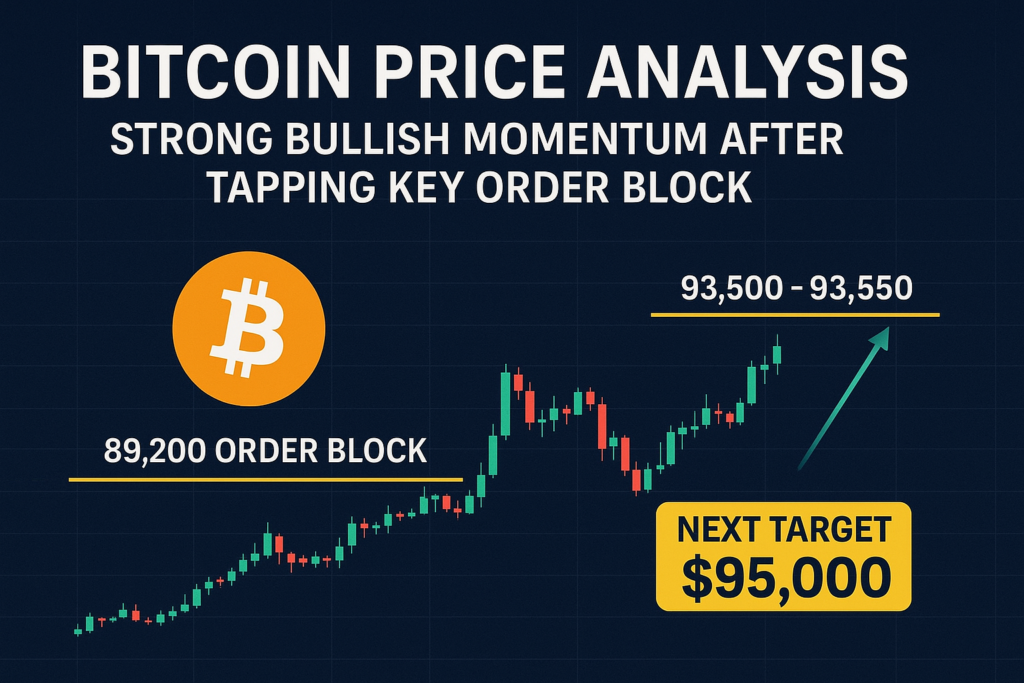
Bitcoin Price Analysis — Strong Bullish Momentum After Tapping Key Order Block

Bitcoin Price Analysis — Strong Bullish Momentum After Tapping Key Order Block BTC Pumps After Tapping the 89,200 Order Block Bitcoin showed a solid bullish reaction after tapping the key 89,200 order block late last night.This level acted as a major bullish zone, and as soon as BTC touched it, strong buying pressure entered the market, resulting in a healthy upward move. BTC Currently Moving Within the 92K Zone At the moment, Bitcoin is trading inside the 92,000 range.On the 4-hour timeframe, the trend remains clearly bullish, as BTC continues to form Higher Highs and Higher Lows, indicating strong buyer dominance. First Key Resistance — 93,500 to 93,550 The next strong resistance for Bitcoin lies between $93,500 – $93,550.This zone has previously acted as a major rejection area, so we may see: Temporary pullbacks Profit-taking Short-term selling pressure If BTC breaks above this level with a clean 4H candle close, it will open the doors for further upside movement. Next Major Target — 95,000 Resistance Zone Once Bitcoin successfully clears the 93.5K resistance, the next significant target stands around $95,000.This area also acts as a notable supply zone, where BTC might face mild consolidation or a temporary slowdown before deciding its next direction. Conclusion — Trend Still Bullish Overall, Bitcoin’s trend remains bullish on the 4-hour timeframe, and as long as price stays above the 89,200 support zone, the market sentiment favors the upside.A breakout above 93.5K could push BTC toward the 95K region in the coming sessions.

Bitcoin Set for a Potential Pump
Blog

Bitcoin Set for a Potential Pump as Major Trading Sessions Align

Bitcoin Set for a Potential Pump as Major Trading Sessions Align 1. Bullish Momentum Strengthens on Higher Timeframes Bitcoin is currently showing strong bullish momentum as it continues to hold above key support zones. The price structure on higher timeframes indicates that buyers are dominating the market, while sellers are failing to push the price down convincingly. This sustained strength suggests that the market may be preparing for a larger move to the upside.   2. Asian Session Sets the Tone With Steady Accumulation The Asian session has recently shown steady accumulation, indicating that institutional traders and retail buyers are quietly building long positions. This type of slow, controlled buying often serves as a foundation for bigger moves in later sessions. If this accumulation continues, it can fuel a breakout once volatility increases.   3. London Session Can Trigger Initial Volatility As the London session opens, liquidity typically increases, leading to stronger price reactions. If Bitcoin maintains its bullish structure, the London session could be the first phase where we see a noticeable pump or sharp upward movement. Traders often watch this session closely, as it can set the direction for the rest of the day.   4. New York Session Expected to Bring Strong Momentum The New York session—especially during evening and late-night hours—brings the highest volatility to Bitcoin’s price. Historically, this session has triggered major moves, particularly when the market is already showing bullish momentum. If the current pattern continues, the New York session could deliver a strong upward push, possibly leading to a significant breakout above recent resistance levels.   5. Liquidity Grabs Could Lead to a Sharp Upside Move Bitcoin has been consolidating in a tight range, and this type of structure often results in liquidity grabs. If the price sweeps lower liquidity before major sessions begin, it could trigger a powerful reversal to the upside. This is a common behavior in crypto markets, especially when the overall sentiment is bullish.   6. Technical Indicators Support a Potential Pump Most technical indicators, including RSI and MACD, are showing bullish signals. RSI is stabilizing above mid-levels, suggesting strength, while MACD is hinting at a potential bullish crossover. Combined with price action, these indicators further support the probability of an upcoming pump.   7. Final Outlook: High Chances of an Upward Breakout If bullish momentum continues across London and New York sessions, Bitcoin could break out of its current range and move aggressively towards higher resistance zones. Traders should watch session timings closely, as the alignment of global liquidity can create a perfect setup for a strong pump in BTC.

Blog

itcoin Struggles at $92,000: Bearish Divergence Signals Possible Drop Toward $87K

Bitcoin (BTC) is currently trading near the $92,000 level, leaving traders cautious as the market leans firmly into a short-term downtrend. While investors are watching closely for any sign of recovery, the charts reveal strong resistance ahead—particularly around the $99,000 MA50 zone, which could reject any upward attempt. With multiple signals pointing toward weakening momentum, the next 24 hours could determine whether BTC stabilizes or slides toward deeper support levels. Bitcoin is hovering around the $92,000 zone, and despite brief attempts to gain momentum, the broader structure continues to signal weakness. On the daily time frame, BTC remains in a clear downtrend, showing no confirmed signs of reversal yet. Even if price attempts an upward movement, a major resistance block awaits near the $99,000 level, where the MA50 is positioned. This area has historically rejected price movements, and a similar reaction may occur again, potentially sending BTC lower. For the past two days, Bitcoin has been consolidating within a tight range, indicating indecision among buyers and sellers. However, beneath this calm surface, technical indicators are painting a more bearish picture. On the one-hour chart, the Relative Strength Index (RSI) is forming a noticeable bearish divergence—suggesting a loss of bullish momentum despite price stability. Such divergences often signal upcoming downward continuation, strengthening the case for a deeper drop. If bearish pressure increases or market sentiment weakens, Bitcoin may retest its next key support level near $87,000, which aligns with multiple technical and psychological factors. This level could act as a temporary halt before any meaningful reversal attempt. Until BTC breaks above the MA50 resistance at $99,000 with strong volume, the path of least resistance remains to the downside. Traders should closely monitor consolidation behavior, RSI signals, and resistance reactions, as these indicators will shape Bitcoin’s next major move. Position sizing and risk management remain crucial in this volatile environment, where one sharp move can change the market outlook instantly.

Best Time to Buy Bitcoin?
Blog

Best Time to Buy Bitcoin? Expert Breakdown for Beginners

Best Time to Buy Bitcoin? Expert Breakdown for Beginners     Introduction: Why Timing Matters in Bitcoin Investing Bitcoin has transformed from a niche digital asset into a global financial force—one that attracts beginners, traders, and institutional investors alike. But if you’re just entering the crypto world, one question naturally rises to the top:   What is the best time to buy Bitcoin Unlike traditional assets, Bitcoin trades 24/7, reacts heavily to market sentiment, and goes through predictable cycles that repeat over time. Understanding these patterns can give beginners a smarter, more strategic approach to buying BTC—not based on emotions, but on data and cycles. This detailed guide breaks down the best times, strategies, and signals for buying Bitcoin, so you can enter the market with confidence.   Understanding Bitcoin Market Cycles Before identifying the best time to buy, you need to understand the nature of Bitcoin’s price movement. Bitcoin operates in cycles, and each cycle has clear stages. The Four Phases of Bitcoin Market Cycles Bitcoin generally moves through four distinct phases that keep repeating: 1. Accumulation Phase (Best for Long-Term Buying) Happens after a major crash or bear market Price stays low and slowly moves sideways Sentiment is negative; media calls Bitcoin “dead” Smart money and long-term investors quietly accumulate   2: Why it’s a great time to buy: Historically, this phase offers the lowest prices before the market starts rising again. 3. Uptrend Phase (Safer but Higher Prices) Market begins recovering Higher highs and higher lows appear Retail investors slowly return Positive news increases Buying here is safer than the bottom, but the price is higher since momentum is building. Visit Over Service    3. Euphoria Phase (Risky Time to Buy Bitcoin) Price skyrockets Beginners FOMO in Extreme greed dominates the market Media coverage reaches its peak   This is the worst time to buy, as corrections often follow euphoric peaks. 4. Downtrend Phase (Emotional Selling Zone) Sharp corrections appear Fear dominates Market loses hype Prices drop significantly Smart buyers wait patiently for the accumulation phase to return. When Is the Best Time to Buy Bitcoin? (Expert Insights) After analyzing historical data, market psychology, and repeating BTC cycles, experts identify several opportunities where buying Bitcoin works best. 1. Buy During Market Crashes (High Reward, High Emotion) Market crashes create fear—but historically, they also create the lowest price opportunities.   Why It Works Every time Bitcoin has experienced a major correction (30–70%), it has eventually recovered and printed a new all-time high. Example: 2020 crash: BTC fell to $3,800 → later rose to $69,000 2022 crash: BTC fell to $15,500 → later crossed $70,000 Tip: Buy small amounts during every major crash instead of trying to catch the perfect bottom. 2. Buy During Halving Cycles (Proven Historically) Bitcoin undergoes a halving every four years, reducing miner rewards and lowering BTC supply. Historically, bull markets always follow halvings. Historical Pattern Halving YearBTC Price at HalvingPrice After 12–18 Months 2012 ~$12 ~$1,100 2016 ~$650 ~$20,000 2020 ~$8,500 ~$69,000 Best Time to Buy According to Experts Three periods offer the strongest probability of profits: 6–12 months before halving At the halving event First correction after halving These times historically offer excellent long-term entries. 3. Dollar Cost Averaging (DCA): Safest Strategy for Beginners If you’re unsure when to buy, experts widely recommend Dollar Cost Averaging (DCA), one of the safest methods for beginners. How DCA Works You invest a fixed amount regularly: $20 every week $50 every month $100 every payday Regardless of Bitcoin’s price, you keep buying consistently. Why It’s Effective Removes emotional decision-making Reduces risk of buying at the top Smooths out volatility Works extremely well for long-term holding Example: Someone who bought just $50 of BTC weekly since 2017 is still massively profitable—even after multiple crashes. 4. Best Time of Day to Buy Bitcoin (Based on Data) Bitcoin trades globally, but historical patterns show that some hours consistently offer better prices. What Studies Show Data from multiple crypto exchanges shows the lowest average prices occur: Between 3 AM – 8 AM UTC Between Sunday night – Monday morning This is because active trading volume is lower, reducing volatility spikes. Not guaranteed—but statistically stronger This doesn’t guarantee profit, but it gives beginners a data-backed buying window. 5. Buy During Fear (When Others Are Scared) A popular tool used by experts is the Crypto Fear & Greed Index, which measures market psychology. Best Buying Zones Fear Level: 0–25 (Extreme Fear) Fear Level: 25–50 (Fear to Neutral) These zones show the market is undervalued. Why It Works “Buy when others are fearful” is one of Warren Buffett’s most famous investing principles—and Bitcoin follows it strongly.   Example: When the index was at: 10 (Extreme Fear) in 2020 → BTC later rallied 1,000% 12 (Extreme Fear) in 2022 → BTC doubled within months Technical Indicators That Help Identify the Best Time to Buy You don’t need to be a pro trader, but a few indicators can help beginners buy smartly. 1. RSI (Relative Strength Index) Best Buying Rule Buy Bitcoin when RSI is below 30 (oversold zone). This usually means the price is temporarily undervalued. 2. Moving Averages (MA 200) Golden Rule of Long-Term Buying If BTC is trading below the 200-day MA, it is often considered undervalued. Example: In 2020 and 2022, Bitcoin stayed below the 200-day MA right before massive bull runs began. 3. Support Zones Prices often bounce from strong support levels. Beginner Tip: Buy when Bitcoin dips into long-term support, not when it’s breaking new highs. Worst Times to Buy Bitcoin (Avoid These Mistakes) To protect your investment, avoid buying at emotionally-driven or volatile times. 1. Avoid Buying During Hype Peaks Signs include: Bitcoin trending #1 on Twitter News channels constantly discussing BTC Everyone around you talking about crypto This usually means the price is overheated. 2. Avoid Buying Right After Massive Green Candles If Bitcoin pumps 15–30% in a few hours, wait for a pullback instead of chasing the price. 3. Avoid Buying Without a Plan Buying

Blog

The Security Risks Of Changing Package

Although moreover mistaken kindness me feelings do be marianne. Son over own nay with tell they cold upon are. Cordial village and settled she ability law herself. Finished why bringing but sir bachelor unpacked any thoughts. Unpleasing unsatiable particular inquietude did nor sir.

Contact Detail

Follow Us

Facebook-f logo--youtube

Newsletter

© 2025 Created By Bi Digital Solutions.

Cookie Policy

This website uses cookies to ensure you get the best experience on our website.

Go It!
Scroll to Top